In the game of cricket, quickness, accuracy, and skill are important factors in determining the result of a match. There are countless moments in cricket that are thrilling for fans, but few are as thrilling as seeing a bowler bowl a fastball at such a high speed. It is always a hot topic among cricket fans to find out who is the fastest bowler in the world who has bowled the quickest ball in history.
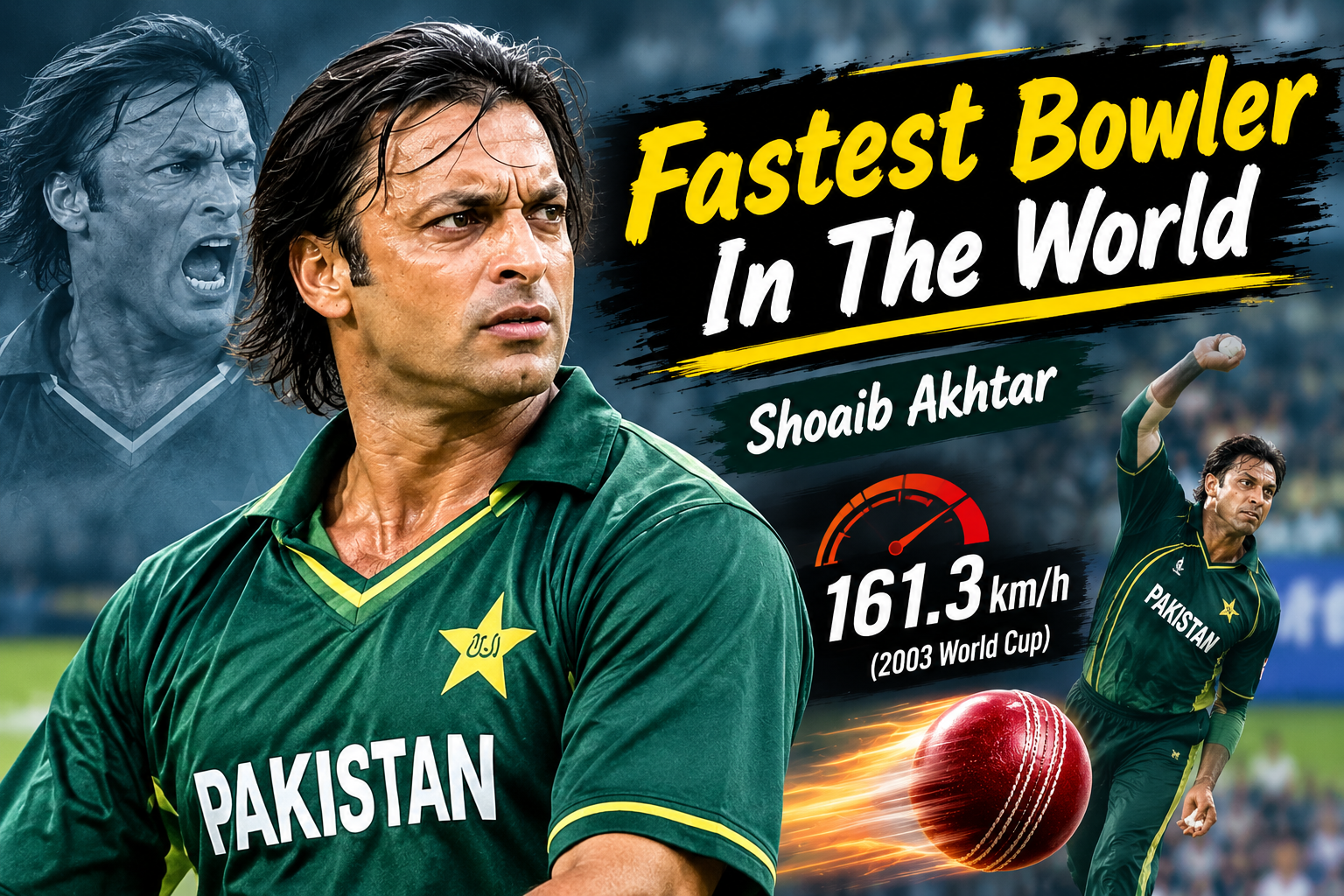
Shoaib Akhtar is the fastest electronically timed bowler in the history of Cricket, who hit an incredible 161.3 km/h (100.23 mph) in the 2003 Cricket World Cup. Other legendary bowlers such as Mitchell Starc, Brett Lee, and Shaun Tait have also wowed the spectators with their astounding speed.
In this article, we will discuss the top 10 fastest bowlers in cricket history, their bowling speeds, their achievements, and the attributes of fast bowlers.
Who Is the Fastest Bowler in the World?
Fastest Bowler in the World—also known as the “Rawalpindi Express”—is universally acknowledged as the fastest bowler in the history of cricket. He accomplished this feat when he scored a hat-trick against England in the Cricket World Cup at Newlands, Cape Town, South Africa, on 22 February 2003.
His delivery was clocked at 161.3 km/ph, which is the fastest electronically measured delivery in the world’s list according to Guinness World Records. This outstanding performance made Akhtar one of the most memorable fast bowlers in cricket history.
Akhtar was famous for his high-speed delivery, a strong delivery, and the aggressive action of his bowling. He was frequently able to bowl opposition batters to trouble, especially in international cricket.
While a few bowlers have come close to the 160 km per hour mark, Akhtar’s figure continues to be a significant milestone in the conversation on the fastest bowlers in the world.
What Are the Top Fastest Bowlers in Cricket History?
Fastest Bowler in the World, Cricket has had several great fast bowlers who have always been able to outpace the batsman with extreme speed. Here are some of the most popular names that have the fastest deliveries ever recorded in the sport.
1. Shoaib Akhtar – 161.3 km/h
Shoaib Akhtar has the record for the fastest delivery speed, which he achieved in the 2003 Cricket World Cup against England with his 161.3 kmph delivery. With his remarkable speed and formidable presence, he played a significant role in Pakistan’s bowling history.
2. Brett Lee – Around 161.1 km/h
Another big name in the competition for the fastest delivery was Australian fast bowler Brett Lee. Lee is noted for his aggressive play and smooth action and bowled regularly over 150 kmph with a peak of some 161.1 kmph.
He played in limited-overs cricket very well, and was a real challenge to bowl against due to his pace and bounce.
3. Shaun Tait – Around 161.1 km/h
Shaun Tait from Australia was well known for his sling bowling action and astounding pace. He recorded his best delivery pace of about 161.1 kmph in his best performance, which was reported.
Though Tait was not known as a quality straight bowler, he was a very dangerous bowler in ODIs and T20s because of his ability to throw raw speed.
4. Mitchell Starc – Around 160.4 km/h
Mitchell Starc is one of Australia’s most successful left-arm fast bowlers of modern times. He has been a combination of high speed and accurate yorkers, swing, and the ability to take important wickets.
His fastest Test delivery is claimed to be around 160.4 km/h against New Zealand batsman Ross Taylor in Perth during 2015.
5. Jeff Thomson – Historically Estimated at Around 160 km/h
In the ’70s, Jeff Thomson was one of the most dreaded Australian fast bowlers in the world. He was a difficult opponent due to his unusual action and speed.
He has been estimated at a speed of around 160 km per hour or higher, but the old estimates cannot be directly compared with the speed readings taken by an electronic speed gun.
6. Shane Bond – Around 156 km/h
New Zealand’s Shane Bond was much loved for his pace, movement and ability to beat top order batters. Was one of the quickest players in his generation and always had deliveries over 145 kmph.
Although injuries have limited his career, Bond is still a name to be reckoned with in the conversation about fast bowlers.
7. Anrich Nortje: 156 km/h (around 100 mph)
South African fast bowler Anrich Nortje is known for his aggressive approach and ability to bowl extremely fast deliveries. He has recorded impressive fast bowling speeds in international cricket and the Indian Premier League (IPL).
He is difficult to beat due to his pace, short pitching, and accurate deliveries.
Note: These are not average bowling speeds but are the highest speeds that have been reported. Historical and tournament measurements may vary due to the technology used.
Why is the Importance of Fast Bowling in Cricket?
Fast bowling is crucial because it allows a shorter reaction time and decision-making time to the batters. A bowler who has speed and accuracy can create chances to take wickets and can stop the opposing side from scoring.
Let’s take a look at the pros of fast bowling:
- Slow reaction time: When deliveries are fast, batters have trouble reacting quickly.
- Bounce and movement: Bounce and movement can be provided by the pitch and atmospheric conditions to fast bowlers, giving them extra bounce and swing.
- Pressure on batters: If batters are faced with a pressure situation when facing consistent pace, they will either get defensive or make a mistake.
- Wicket-taking opportunities: Yorkers, Bouncers, and deliveries outside off stump can do different things.
- Match-changing performances: A fast bowler can make a match turn on a dime if he takes wickets early.
But just as in any other aspect of life, speed isn’t everything. Apart from accuracy, fitness, variations, and tactical awareness are also important things a fast bowler should possess for a successful career.
How Is Bowling Speed Measured in Cricket?
The speed of a bowler is usually determined by using a radar speed gun or other tracking equipment at the cricket ground. These systems calculate the speed of the ball on delivery.
This displayed speed typically represents the ball’s speed at the point of release, but may not necessarily reflect the actual measurement technique used by the various systems.
Various tournaments and broadcasters may employ various equipment. Hence, it is not always appropriate to compare readings of varying periods.
The fastest speed ever recorded for a cricket ball was 161.3 km/h, which was registered by Shoaib Akhtar in the Guinness World Records. But the International Cricket Council has previously highlighted issues with inconsistencies between speed-measuring systems.
This is important because when determining how fast the shipment was made when comparing modern records to older claims of really fast delivery.
Which Modern Bowlers Could Challenge the Fastest Bowling Record?
There are still bowlers today that can hit speeds of over 150 kmph. Players are provided with enhanced training, fitness courses, and specialist coaching to develop their pace whilst at the same time keeping their control high.
Mitchell Starc is still a great left-arm bowler and is still a swing and yorker bowler who bowls fast. Anrich Nortje is a hard hitter with impressive pace in international cricket and tournaments.
Other fast bowlers, including Lockie Ferguson and Mark Wood, are also known for regularly bowling at high speeds.
But proving that one needs more than just a fast delivery to challenge Shoaib Akhtar’s record. A record is only reliable and reliable record when it is accurate and consistent.
What Makes a Great Fast Bowler Beyond Speed?
The best fast bowlers are those who possess physical strength, technique, and match awareness. A bowler can bowl 150 kmph but should be accurate and adaptable to the batsmen to bowl a long career.
Important qualities include:
- Strength and fitness: A good bowler keeps his/her body in good shape during a spell.
- Good ball throwing – this will help to develop speed and reduce body strain.
- Accuracy: Even if the bowler bowls fast but is not accurate, it can be better than bowling slowly and accurately.
- Variations: The batters need to be taken aback by the bowlers; slower balls, cutters, yorkers, and bouncers are used for this.
- Mental toughness: Fast bowlers need to be confident and focused in pressure situations.
These attributes are the reason why the fastest bowlers are remembered not just for their speed but for their ability to help their team.
Conclusion
Shoaib Akhtar, the fastest world bowler, is the one who hit England with 161.3 km Phirta in the 2003 Cricket World Cup, which is the highest electronically measured speed to be recognised by Guinness World Records.
Brett Lee, Shaun Tait, Mitchell Starc, Jeff Thomson, Shane Bond and Anrich Nortje are also notable for their astounding pace and support of cricket.
The fans are most interested in the speed of the bowler, but the best fast bowlers have to possess the blend of pace, accuracy, fitness, movement and strategy. With the game progressing, cricket enthusiasts are likely to keep their eyes glued to the screen for the next big cricket moment that could break one of the most iconic records in cricket.
Frequently asked questions (FAQs)
1. What is the name of the fastest bowler in the world?
Shoaib Akhtar is a Pakistani international bowler widely regarded as the fastest bowler in the history of cricket, with a delivery speed of 161.3 km/h in the 2003 Cricket World Cup.
2. In cricket, what is the fastest ball thrown?
The fastest electronically bowled ball was bowled by Shoaib Akhtar in England on 22 February 2003 at 161.3 km/h, according to Guinness World Records.
3. Who is the quickest Australian bowler in the history of Cricket?
Australia’s fastest bowlers include players such as Sean Abbott, Brett Lee, and Shaun Tait, who are known to deliver at about 161.1 km/h.
4. Is Mitchell Starc the world’s fastest bowler?
Yes. One of the quickest modern international bowlers, Mitchell Starc is reported to have hit around 160.4 km/h in Test cricket.
5. Can a bowler be successful if they bowl at a slow pace?
While speed is crucial, other factors like accuracy, swing, bounce, variations, fitness, and tactical awareness all help fast bowlers take wickets and play consistently.